
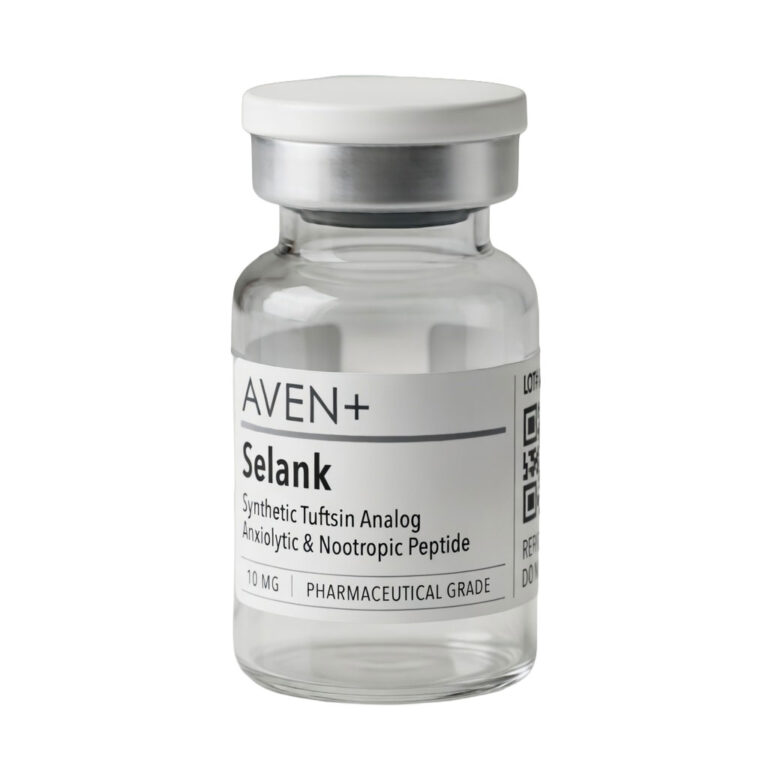
Selank (10mg)
$49.99 – $374.93Price range: $49.99 through $374.93
Free Ship at $200+
Online Chat Support
99% Purity Guaranteed
Selank (10mg)
Selank is a synthetic heptapeptide created by conjugating a Pro-Gly-Pro extension to the immunomodulatory tetrapeptide tuftsin. Developed at the Institute of Molecular Genetics of the Russian Academy of Sciences, it is registered as an anxiolytic drug in Russia and Ukraine. Its primary research distinction is non-sedating anxiolysis—reducing anxiety without the sedation, tolerance, or dependence of benzodiazepines. Secondary research areas include BDNF upregulation, tuftsin-receptor immunomodulation, and HPA axis normalization.
Starting from: $49.99 – $374.93Price range: $49.99 through $374.93
Aven Peptides Guarantee
Every Aven Peptides Guarantee product is released through a controlled quality framework verifying identity, purity, consistency, endotoxin levels, and heavy metal content. Each batch undergoes analytical testing to confirm peptide composition prior to distribution, including independent laboratory verification using chromatographic and mass spectrometry methods. Only batches that pass internal quality review and release authorization enter circulation, reflecting our commitment to rigorous testing, documentation, traceability, and the continuous pursuit of uncompromising quality.
Selank is a synthetic heptapeptide created by conjugating a Pro-Gly-Pro extension to the immunomodulatory tetrapeptide tuftsin. Developed at the Institute of Molecular Genetics of the Russian Academy of Sciences, it is registered as an anxiolytic drug in Russia and Ukraine. Its primary research distinction is non-sedating anxiolysis—reducing anxiety without the sedation, tolerance, or dependence of benzodiazepines. Secondary research areas include BDNF upregulation, tuftsin-receptor immunomodulation, and HPA axis normalization.
Key Findings at a Glance
- Selank is a synthetic analog of the immune peptide tuftsin with an added Pro-Gly-Pro sequence that dramatically increases its stability and half-life in the body.
- Selank is approved in Russia as an anxiolytic medication, making it one of very few peptides prescribed specifically for anxiety disorders in any country.
- Research shows Selank modulates the expression of over 50 genes related to inflammation and immune response, suggesting effects far beyond simple anxiety reduction.
- Selank influences GABA-ergic neurotransmission without the sedation, tolerance, or dependence typically seen with conventional GABA-enhancing anxiolytics like benzodiazepines.
Mechanism of Action: Neuroprotection & Synaptic Plasticity
Selank modulates the expression of brain-derived neurotrophic factor (BDNF) and affects the balance of various neurotransmitter systems including GABA, serotonin, and dopamine. It inhibits enkephalin-degrading enzymes, leading to increased enkephalin levels. Research indicates effects on gene expression related to immune function and stress response. The peptide also shows immunomodulatory effects through its relationship to tuftsin.
Anxiolytic Activity
Extensive clinical and preclinical research demonstrates Selank’s potent anxiety-reducing effects through modulation of GABAergic neurotransmission and serotonin system regulation without causing sedation or cognitive impairment commonly associated with benzodiazepine anxiolytics. Studies in animal models of generalized anxiety disorder show significant reduction in anxiety-related behaviors within 30 minutes of intranasal administration, with effects persisting for several hours beyond the peptide’s plasma half-life. Unlike traditional anti-anxiety medications, Selank does not produce tolerance, dependence, or withdrawal symptoms even after prolonged administration in research settings, making it valuable for chronic anxiety treatment studies. The peptide inhibits enkephalin-degrading enzymes including enkephalinase and carboxypeptidase, leading to increased endogenous enkephalin levels that contribute to its calming effects through opioid receptor modulation. Research indicates potential applications in social anxiety disorder treatment, panic disorder mechanisms, and stress-related anxiety research where sedation-free anxiolysis is essential for accurate behavioral assessment.
Cognitive Enhancement
Research demonstrates significant improvements in memory consolidation, learning acquisition, and sustained attention through Selank’s modulation of brain-derived neurotrophic factor (BDNF) expression in hippocampal and cortical brain regions essential for cognitive function. Studies show the peptide enhances long-term potentiation (LTP), the cellular mechanism underlying memory formation, with improvements of 25-40% in memory retention tests compared to control groups in animal models. Selank influences the expression of over 80 genes related to cognitive function including those involved in neurotransmitter synthesis, synaptic plasticity, and neuronal survival pathways. Research in attention and focus paradigms demonstrates enhanced performance on sustained attention tasks and reduced cognitive interference, suggesting potential applications in attention deficit research and cognitive aging studies. The peptide’s nootropic effects appear synergistic with its anxiolytic properties, as reduced anxiety contributes to improved cognitive performance in research subjects, making it valuable for studying the anxiety-cognition relationship.
Immunomodulation
As a synthetic analog of the endogenous immunomodulatory peptide tuftsin, Selank demonstrates significant effects on immune cell function including enhanced phagocytic activity of monocytes and macrophages, increased natural killer cell cytotoxicity, and modulation of cytokine production profiles. Research shows the peptide stimulates IL-6 expression while balancing pro-inflammatory and anti-inflammatory cytokine ratios, contributing to optimized immune response without excessive inflammation. Studies document improved antibody production and enhanced T-lymphocyte function in immunocompromised research models, suggesting potential applications in immunodeficiency research and adjuvant therapy studies. The immunomodulatory effects appear independent of the peptide’s anxiolytic actions, operating through specific tuftsin receptor-mediated pathways on immune cells. Research has explored Selank’s potential in autoimmune condition models, viral infection research, and immune system optimization studies, with findings indicating it may help restore balanced immune function in dysregulated states.
Stress Adaptation
Research demonstrates Selank’s significant adaptogenic properties through modulation of the hypothalamic-pituitary-adrenal (HPA) axis, the primary stress response system, resulting in normalized cortisol levels and improved stress resilience in chronic stress models. Studies show the peptide reduces stress-induced increases in corticosterone (the rodent equivalent of cortisol) by up to 50% while simultaneously enhancing expression of stress-protective heat shock proteins and antioxidant enzymes. Selank appears to enhance serotonin metabolism and dopamine turnover in brain regions associated with stress processing, contributing to improved emotional regulation under challenging conditions. Research in models of chronic unpredictable stress demonstrates preserved cognitive function and reduced depressive-like behaviors in Selank-treated subjects compared to untreated controls. The peptide’s stress-protective effects have implications for research into post-traumatic stress disorder (PTSD), burnout syndrome, and chronic fatigue conditions where dysregulated stress responses contribute to pathology.
Only logged in customers who have purchased this product may leave a review.
Lyophilized (freeze-dried) peptides should be stored in a refrigerator at 2–8°C (36–46°F). For long-term storage, they should be kept in a freezer at -20°C (-4°F) or below. Once reconstituted, peptides must be stored in a refrigerator at 2–8°C (36–46°F) and should not be left at room temperature for extended periods.
Add 1mL of bacteriostatic water to get a solution that is 10mg/mL, such that every 0.1mL (10 units on an insulin syringe) is equal to 1mg of Selank.
-
Description
Selank is a synthetic heptapeptide created by conjugating a Pro-Gly-Pro extension to the immunomodulatory tetrapeptide tuftsin. Developed at the Institute of Molecular Genetics of the Russian Academy of Sciences, it is registered as an anxiolytic drug in Russia and Ukraine. Its primary research distinction is non-sedating anxiolysis—reducing anxiety without the sedation, tolerance, or dependence of benzodiazepines. Secondary research areas include BDNF upregulation, tuftsin-receptor immunomodulation, and HPA axis normalization.
Key Findings at a Glance
- Selank is a synthetic analog of the immune peptide tuftsin with an added Pro-Gly-Pro sequence that dramatically increases its stability and half-life in the body.
- Selank is approved in Russia as an anxiolytic medication, making it one of very few peptides prescribed specifically for anxiety disorders in any country.
- Research shows Selank modulates the expression of over 50 genes related to inflammation and immune response, suggesting effects far beyond simple anxiety reduction.
- Selank influences GABA-ergic neurotransmission without the sedation, tolerance, or dependence typically seen with conventional GABA-enhancing anxiolytics like benzodiazepines.
Mechanism of Action: Neuroprotection & Synaptic Plasticity
Selank modulates the expression of brain-derived neurotrophic factor (BDNF) and affects the balance of various neurotransmitter systems including GABA, serotonin, and dopamine. It inhibits enkephalin-degrading enzymes, leading to increased enkephalin levels. Research indicates effects on gene expression related to immune function and stress response. The peptide also shows immunomodulatory effects through its relationship to tuftsin.
Anxiolytic Activity
Extensive clinical and preclinical research demonstrates Selank’s potent anxiety-reducing effects through modulation of GABAergic neurotransmission and serotonin system regulation without causing sedation or cognitive impairment commonly associated with benzodiazepine anxiolytics. Studies in animal models of generalized anxiety disorder show significant reduction in anxiety-related behaviors within 30 minutes of intranasal administration, with effects persisting for several hours beyond the peptide’s plasma half-life. Unlike traditional anti-anxiety medications, Selank does not produce tolerance, dependence, or withdrawal symptoms even after prolonged administration in research settings, making it valuable for chronic anxiety treatment studies. The peptide inhibits enkephalin-degrading enzymes including enkephalinase and carboxypeptidase, leading to increased endogenous enkephalin levels that contribute to its calming effects through opioid receptor modulation. Research indicates potential applications in social anxiety disorder treatment, panic disorder mechanisms, and stress-related anxiety research where sedation-free anxiolysis is essential for accurate behavioral assessment.
Cognitive Enhancement
Research demonstrates significant improvements in memory consolidation, learning acquisition, and sustained attention through Selank’s modulation of brain-derived neurotrophic factor (BDNF) expression in hippocampal and cortical brain regions essential for cognitive function. Studies show the peptide enhances long-term potentiation (LTP), the cellular mechanism underlying memory formation, with improvements of 25-40% in memory retention tests compared to control groups in animal models. Selank influences the expression of over 80 genes related to cognitive function including those involved in neurotransmitter synthesis, synaptic plasticity, and neuronal survival pathways. Research in attention and focus paradigms demonstrates enhanced performance on sustained attention tasks and reduced cognitive interference, suggesting potential applications in attention deficit research and cognitive aging studies. The peptide’s nootropic effects appear synergistic with its anxiolytic properties, as reduced anxiety contributes to improved cognitive performance in research subjects, making it valuable for studying the anxiety-cognition relationship.
Immunomodulation
As a synthetic analog of the endogenous immunomodulatory peptide tuftsin, Selank demonstrates significant effects on immune cell function including enhanced phagocytic activity of monocytes and macrophages, increased natural killer cell cytotoxicity, and modulation of cytokine production profiles. Research shows the peptide stimulates IL-6 expression while balancing pro-inflammatory and anti-inflammatory cytokine ratios, contributing to optimized immune response without excessive inflammation. Studies document improved antibody production and enhanced T-lymphocyte function in immunocompromised research models, suggesting potential applications in immunodeficiency research and adjuvant therapy studies. The immunomodulatory effects appear independent of the peptide’s anxiolytic actions, operating through specific tuftsin receptor-mediated pathways on immune cells. Research has explored Selank’s potential in autoimmune condition models, viral infection research, and immune system optimization studies, with findings indicating it may help restore balanced immune function in dysregulated states.
Stress Adaptation
Research demonstrates Selank’s significant adaptogenic properties through modulation of the hypothalamic-pituitary-adrenal (HPA) axis, the primary stress response system, resulting in normalized cortisol levels and improved stress resilience in chronic stress models. Studies show the peptide reduces stress-induced increases in corticosterone (the rodent equivalent of cortisol) by up to 50% while simultaneously enhancing expression of stress-protective heat shock proteins and antioxidant enzymes. Selank appears to enhance serotonin metabolism and dopamine turnover in brain regions associated with stress processing, contributing to improved emotional regulation under challenging conditions. Research in models of chronic unpredictable stress demonstrates preserved cognitive function and reduced depressive-like behaviors in Selank-treated subjects compared to untreated controls. The peptide’s stress-protective effects have implications for research into post-traumatic stress disorder (PTSD), burnout syndrome, and chronic fatigue conditions where dysregulated stress responses contribute to pathology.
-
Reviews (0)
Reviews
There are no reviews yet.
Only logged in customers who have purchased this product may leave a review.
-
Storage Instructions
Lyophilized (freeze-dried) peptides should be stored in a refrigerator at 2–8°C (36–46°F). For long-term storage, they should be kept in a freezer at -20°C (-4°F) or below. Once reconstituted, peptides must be stored in a refrigerator at 2–8°C (36–46°F) and should not be left at room temperature for extended periods.
-
Reconstitution
Add 1mL of bacteriostatic water to get a solution that is 10mg/mL, such that every 0.1mL (10 units on an insulin syringe) is equal to 1mg of Selank.

Reviews
There are no reviews yet.