
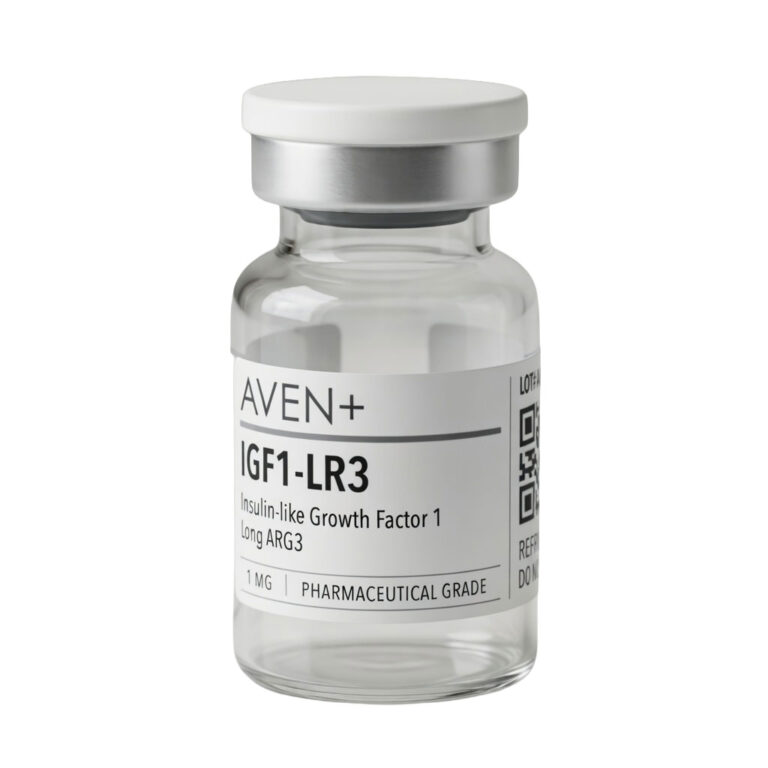
IGF-1 LR3 (Long Arg³ Insulin-Like Growth Factor-1) is a modified research peptide analog of human IGF-1, engineered with an N-terminal extension and amino acid substitution to enhance stability, receptor affinity, and biological activity in experimental settings. Due to these properties, IGF-1 LR3 is widely used in cell growth, anabolic signaling, metabolic regulation, and tissue remodeling research.
1. Enhances Cellular Growth and Proliferation
One of the primary benefits of IGF-1 LR3 is its strong ability to stimulate cellular growth and proliferation. By binding to the IGF-1 receptor (IGF-1R), it activates intracellular signaling pathways that regulate cell division and survival, making it a valuable compound in growth biology and regenerative research.
2. Activates Potent Anabolic Signaling Pathways
IGF-1 LR3 robustly activates the PI3K/Akt and MAPK/ERK pathways, which are central to anabolic signaling, protein synthesis, and cellular differentiation. These pathways are critical for understanding how cells respond to growth signals under normal and stress conditions.
3. Improved Stability and Extended Activity
Compared to native IGF-1, IGF-1 LR3 has reduced binding to IGF-binding proteins (IGFBPs), resulting in greater bioavailability and prolonged receptor interaction in research models. This enhanced stability makes it ideal for studying sustained growth signaling and receptor kinetics.
4. Supports Tissue Remodeling and Repair Models
IGF-1 signaling plays a key role in tissue regeneration and structural adaptation. IGF-1 LR3 is frequently used in experimental models examining muscle tissue development, connective tissue remodeling, and recovery processes following mechanical or metabolic stress.
5. Influences Muscle Cell Differentiation and Hypertrophy
Research suggests IGF-1 LR3 supports myoblast differentiation and muscle fiber hypertrophy, making it a common tool in studies focused on musculoskeletal biology, cellular hypertrophy, and anabolic response mechanisms.
6. Supports Metabolic Regulation Research
IGF-1 LR3 influences pathways involved in glucose uptake, nutrient utilization, and energy balance. These effects make it useful in research exploring metabolic efficiency, insulin-related signaling, and endocrine system interactions.
7. Useful for Receptor Binding and Signal Transduction Studies
Because of its strong and sustained interaction with the IGF-1 receptor, IGF-1 LR3 is widely used to study receptor activation dynamics, downstream signaling cascades, and feedback regulation in controlled experimental environments.
8. Valuable Tool in Advanced Peptide and Growth Factor Research
IGF-1 LR3 serves as an important model compound for investigating:
Peptide-mediated anabolic signaling
Growth factor receptor pharmacology
Cell cycle regulation
Tissue adaptation and regeneration
Its predictable and potent activity makes it a cornerstone peptide in growth factor and regenerative biochemistry research.
Summary
In research contexts, IGF-1 LR3 is valued for its benefits related to enhanced cellular growth, potent anabolic signaling, improved stability, tissue remodeling support, and metabolic pathway regulation. Its ability to strongly activate IGF-1 receptor pathways makes it an essential peptide for advancing understanding of cell growth, differentiation, and regenerative signaling mechanisms.
1 review for IGF1-LR3 (1mg)
Only logged in customers who have purchased this product may leave a review.
Lyophilized (freeze-dried) peptides should be stored in a refrigerator at 2–8°C (36–46°F). For long-term storage, they should be kept in a freezer at -20°C (-4°F) or below. Once reconstituted, peptides must be stored in a refrigerator at 2–8°C (36–46°F) and should not be left at room temperature for extended periods.
Add 1mL of bacteriostatic water to get a solution that is 1mg/mL, such that every 0.1mL (10 units on an insulin syringe) is equal to 0.1mg of IGF-1 LR3.
-
Description
IGF-1 LR3 (Long Arg³ Insulin-Like Growth Factor-1) is a modified research peptide analog of human IGF-1, engineered with an N-terminal extension and amino acid substitution to enhance stability, receptor affinity, and biological activity in experimental settings. Due to these properties, IGF-1 LR3 is widely used in cell growth, anabolic signaling, metabolic regulation, and tissue remodeling research.
1. Enhances Cellular Growth and Proliferation
One of the primary benefits of IGF-1 LR3 is its strong ability to stimulate cellular growth and proliferation. By binding to the IGF-1 receptor (IGF-1R), it activates intracellular signaling pathways that regulate cell division and survival, making it a valuable compound in growth biology and regenerative research.
2. Activates Potent Anabolic Signaling Pathways
IGF-1 LR3 robustly activates the PI3K/Akt and MAPK/ERK pathways, which are central to anabolic signaling, protein synthesis, and cellular differentiation. These pathways are critical for understanding how cells respond to growth signals under normal and stress conditions.
3. Improved Stability and Extended Activity
Compared to native IGF-1, IGF-1 LR3 has reduced binding to IGF-binding proteins (IGFBPs), resulting in greater bioavailability and prolonged receptor interaction in research models. This enhanced stability makes it ideal for studying sustained growth signaling and receptor kinetics.
4. Supports Tissue Remodeling and Repair Models
IGF-1 signaling plays a key role in tissue regeneration and structural adaptation. IGF-1 LR3 is frequently used in experimental models examining muscle tissue development, connective tissue remodeling, and recovery processes following mechanical or metabolic stress.
5. Influences Muscle Cell Differentiation and Hypertrophy
Research suggests IGF-1 LR3 supports myoblast differentiation and muscle fiber hypertrophy, making it a common tool in studies focused on musculoskeletal biology, cellular hypertrophy, and anabolic response mechanisms.
6. Supports Metabolic Regulation Research
IGF-1 LR3 influences pathways involved in glucose uptake, nutrient utilization, and energy balance. These effects make it useful in research exploring metabolic efficiency, insulin-related signaling, and endocrine system interactions.
7. Useful for Receptor Binding and Signal Transduction Studies
Because of its strong and sustained interaction with the IGF-1 receptor, IGF-1 LR3 is widely used to study receptor activation dynamics, downstream signaling cascades, and feedback regulation in controlled experimental environments.
8. Valuable Tool in Advanced Peptide and Growth Factor Research
IGF-1 LR3 serves as an important model compound for investigating:
Peptide-mediated anabolic signaling
Growth factor receptor pharmacology
Cell cycle regulation
Tissue adaptation and regeneration
Its predictable and potent activity makes it a cornerstone peptide in growth factor and regenerative biochemistry research.
Summary
In research contexts, IGF-1 LR3 is valued for its benefits related to enhanced cellular growth, potent anabolic signaling, improved stability, tissue remodeling support, and metabolic pathway regulation. Its ability to strongly activate IGF-1 receptor pathways makes it an essential peptide for advancing understanding of cell growth, differentiation, and regenerative signaling mechanisms.
-
Reviews (1)
1 review for IGF1-LR3 (1mg)
-
At first I wasn’t really expecting much from IGF-1 LR3, but after using it consistently for about a month, I could definitely notice a difference in both recovery and strength. My body felt less beat up after workouts, and I was able to train harder without feeling as drained the next day. I was also cutting weight at the time and still managed to add two plates to my squat while dropping a few pounds, which honestly impressed me a lot.
Only logged in customers who have purchased this product may leave a review.
-
-
Storage Instructions
Lyophilized (freeze-dried) peptides should be stored in a refrigerator at 2–8°C (36–46°F). For long-term storage, they should be kept in a freezer at -20°C (-4°F) or below. Once reconstituted, peptides must be stored in a refrigerator at 2–8°C (36–46°F) and should not be left at room temperature for extended periods.
-
Reconstitution
Add 1mL of bacteriostatic water to get a solution that is 1mg/mL, such that every 0.1mL (10 units on an insulin syringe) is equal to 0.1mg of IGF-1 LR3.


greenman –
At first I wasn’t really expecting much from IGF-1 LR3, but after using it consistently for about a month, I could definitely notice a difference in both recovery and strength. My body felt less beat up after workouts, and I was able to train harder without feeling as drained the next day. I was also cutting weight at the time and still managed to add two plates to my squat while dropping a few pounds, which honestly impressed me a lot.