
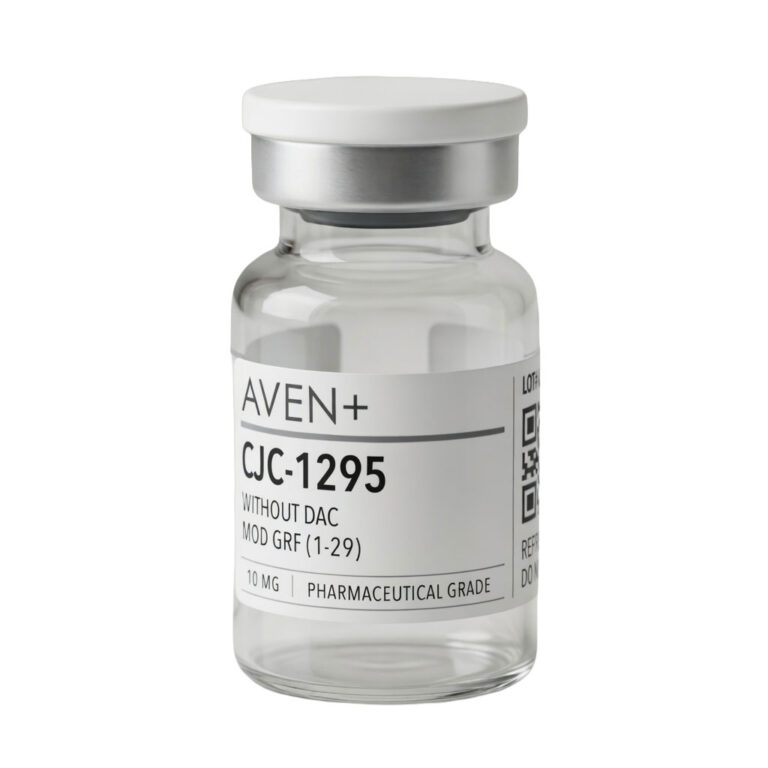
CJC-1295 (No DAC) (10mg)
$69.99 – $524.99Price range: $69.99 through $524.99
Free Ship at $200+
Online Chat Support
99% Purity Guaranteed
CJC-1295 (No DAC) (10mg)
CJC-1295 (No DAC), also known as Modified GRF (1–29), is a research peptide and a stabilized analog of growth hormone–releasing hormone (GHRH 1–29) designed for improved receptor affinity without DAC conjugation. It activates the GHRH receptor, stimulating cAMP and somatotropic signaling pathways under experimental conditions. CJC-1295 (No DAC) is widely used in research focused on peptide pharmacokinetics, growth hormone signaling, and pituitary receptor regulation.
Starting from: $69.99 – $524.99Price range: $69.99 through $524.99
Aven Peptides Guarantee
Every Aven Peptides Guarantee product is released through a controlled quality framework verifying identity, purity, consistency, endotoxin levels, and heavy metal content. Each batch undergoes analytical testing to confirm peptide composition prior to distribution, including independent laboratory verification using chromatographic and mass spectrometry methods. Only batches that pass internal quality review and release authorization enter circulation, reflecting our commitment to rigorous testing, documentation, traceability, and the continuous pursuit of uncompromising quality.
CJC-1295 (No DAC), also known as Modified GRF (1–29), is a research peptide developed as a stabilized analog of growth hormone–releasing hormone (GHRH 1–29). Unlike DAC-conjugated versions, CJC-1295 (No DAC) is designed for shorter activity with precise receptor engagement, making it especially valuable in experimental settings focused on growth hormone signaling and endocrine regulation. Below is a detailed, SEO-friendly overview of the key benefits of CJC-1295 (No DAC) in research contexts.
1. Stimulates Natural Growth Hormone Release
One of the primary benefits of CJC-1295 (No DAC) is its ability to activate the GHRH receptor in the pituitary gland. This activation stimulates the body’s natural pulsatile release of growth hormone (GH) rather than supplying GH directly, allowing researchers to study physiologic hormone signaling patterns.
2. Supports Somatotropic Signaling Pathways
By triggering adenylate cyclase activity and increasing cAMP signaling, CJC-1295 (No DAC) activates downstream somatotropic pathways. These pathways are essential for understanding how growth hormone influences cellular growth, repair mechanisms, and metabolic signaling under controlled experimental conditions.
3. Short-Acting Profile for Precise Research Control
Without Drug Affinity Complex (DAC) conjugation, CJC-1295 (No DAC) has a shorter half-life compared to long-acting variants. This makes it particularly useful for research requiring tight temporal control, allowing scientists to observe acute hormonal responses without prolonged receptor exposure.
4. Preserves Physiological Hormone Rhythms
CJC-1295 (No DAC) is often studied for its ability to maintain natural growth hormone pulse patterns. Preserving these rhythms is important in research models examining endocrine balance, receptor sensitivity, and feedback mechanisms within the hypothalamic–pituitary axis.
5. Useful in Pituitary Receptor Regulation Studies
Because it selectively targets the GHRH receptor, CJC-1295 (No DAC) is a valuable tool for studying pituitary receptor dynamics, including receptor activation, desensitization, and signaling efficiency. This helps advance understanding of hormonal communication at the receptor level.
6. Research Applications in Recovery and Cellular Repair Models
Growth hormone signaling is closely linked to cellular repair, protein synthesis, and tissue regeneration. In experimental models, CJC-1295 (No DAC) is used to explore how endogenous GH release may influence recovery processes following physical or metabolic stress.
7. Favorable Profile for Peptide Pharmacokinetics Research
The non-DAC structure of CJC-1295 (No DAC) makes it ideal for pharmacokinetic and pharmacodynamic studies, allowing researchers to evaluate absorption, receptor interaction, and clearance without the confounding effects of extended binding agents.
8. Valuable Tool in Endocrine and Peptide Research
Overall, CJC-1295 (No DAC) is widely used as a research peptide in studies focused on growth hormone regulation, endocrine signaling pathways, and peptide–receptor interactions. Its specificity and predictable activity profile make it a cornerstone compound in hormonal research.
Summary
In research settings, CJC-1295 (No DAC) is valued for its ability to stimulate natural growth hormone release, support somatotropic signaling, preserve physiological hormone rhythms, and enable precise control in endocrine studies. Its short-acting, receptor-specific design makes it especially useful for investigating growth hormone biology and pituitary regulation mechanisms.
Only logged in customers who have purchased this product may leave a review.
Lyophilized (freeze-dried) peptides should be stored in a refrigerator at 2–8°C (36–46°F). For long-term storage, they should be kept in a freezer at -20°C (-4°F) or below. Once reconstituted, peptides must be stored in a refrigerator at 2–8°C (36–46°F) and should not be left at room temperature for extended periods.
Add 2mL of bacteriostatic water to get a solution that is 5mg/mL, such that every 0.1mL (10 units on an insulin syringe) is equal to 500mcg of CJC-1295 no DAC.
-
Description
CJC-1295 (No DAC), also known as Modified GRF (1–29), is a research peptide developed as a stabilized analog of growth hormone–releasing hormone (GHRH 1–29). Unlike DAC-conjugated versions, CJC-1295 (No DAC) is designed for shorter activity with precise receptor engagement, making it especially valuable in experimental settings focused on growth hormone signaling and endocrine regulation. Below is a detailed, SEO-friendly overview of the key benefits of CJC-1295 (No DAC) in research contexts.
1. Stimulates Natural Growth Hormone Release
One of the primary benefits of CJC-1295 (No DAC) is its ability to activate the GHRH receptor in the pituitary gland. This activation stimulates the body’s natural pulsatile release of growth hormone (GH) rather than supplying GH directly, allowing researchers to study physiologic hormone signaling patterns.
2. Supports Somatotropic Signaling Pathways
By triggering adenylate cyclase activity and increasing cAMP signaling, CJC-1295 (No DAC) activates downstream somatotropic pathways. These pathways are essential for understanding how growth hormone influences cellular growth, repair mechanisms, and metabolic signaling under controlled experimental conditions.
3. Short-Acting Profile for Precise Research Control
Without Drug Affinity Complex (DAC) conjugation, CJC-1295 (No DAC) has a shorter half-life compared to long-acting variants. This makes it particularly useful for research requiring tight temporal control, allowing scientists to observe acute hormonal responses without prolonged receptor exposure.
4. Preserves Physiological Hormone Rhythms
CJC-1295 (No DAC) is often studied for its ability to maintain natural growth hormone pulse patterns. Preserving these rhythms is important in research models examining endocrine balance, receptor sensitivity, and feedback mechanisms within the hypothalamic–pituitary axis.
5. Useful in Pituitary Receptor Regulation Studies
Because it selectively targets the GHRH receptor, CJC-1295 (No DAC) is a valuable tool for studying pituitary receptor dynamics, including receptor activation, desensitization, and signaling efficiency. This helps advance understanding of hormonal communication at the receptor level.
6. Research Applications in Recovery and Cellular Repair Models
Growth hormone signaling is closely linked to cellular repair, protein synthesis, and tissue regeneration. In experimental models, CJC-1295 (No DAC) is used to explore how endogenous GH release may influence recovery processes following physical or metabolic stress.
7. Favorable Profile for Peptide Pharmacokinetics Research
The non-DAC structure of CJC-1295 (No DAC) makes it ideal for pharmacokinetic and pharmacodynamic studies, allowing researchers to evaluate absorption, receptor interaction, and clearance without the confounding effects of extended binding agents.
8. Valuable Tool in Endocrine and Peptide Research
Overall, CJC-1295 (No DAC) is widely used as a research peptide in studies focused on growth hormone regulation, endocrine signaling pathways, and peptide–receptor interactions. Its specificity and predictable activity profile make it a cornerstone compound in hormonal research.
Summary
In research settings, CJC-1295 (No DAC) is valued for its ability to stimulate natural growth hormone release, support somatotropic signaling, preserve physiological hormone rhythms, and enable precise control in endocrine studies. Its short-acting, receptor-specific design makes it especially useful for investigating growth hormone biology and pituitary regulation mechanisms.
-
Reviews (0)
Reviews
There are no reviews yet.
Only logged in customers who have purchased this product may leave a review.
-
Storage Instructions
Lyophilized (freeze-dried) peptides should be stored in a refrigerator at 2–8°C (36–46°F). For long-term storage, they should be kept in a freezer at -20°C (-4°F) or below. Once reconstituted, peptides must be stored in a refrigerator at 2–8°C (36–46°F) and should not be left at room temperature for extended periods.
-
Reconstitution
Add 2mL of bacteriostatic water to get a solution that is 5mg/mL, such that every 0.1mL (10 units on an insulin syringe) is equal to 500mcg of CJC-1295 no DAC.

Reviews
There are no reviews yet.