
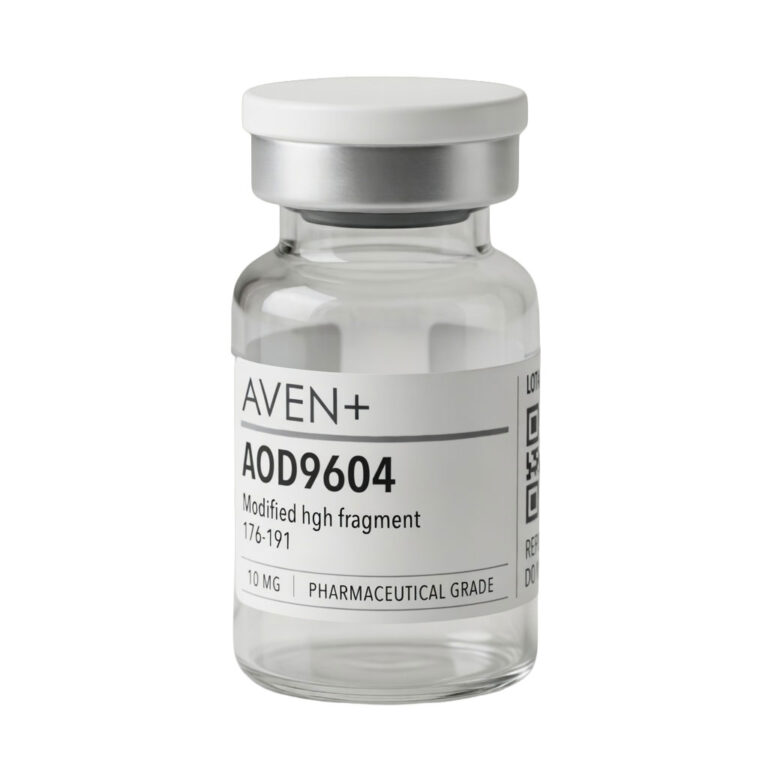
AOD-9604 (10mg)
$79.99 – $599.93Price range: $79.99 through $599.93
Free Ship at $200+
Online Chat Support
99% Purity Guaranteed
AOD-9604 (10mg)
AOD-9604 is a modified fragment of human growth hormone (hGH amino acids 177-191) with an N-terminal tyrosine, developed by Professor Frank Ng at Monash University in collaboration with Metabolic Pharmaceuticals Ltd (Australia). It stimulates lipolysis and inhibits lipogenesis through beta-3 adrenergic receptor upregulation without the growth-promoting effects of full hGH. Six clinical trials enrolling ~900 participants demonstrated excellent safety but the pivotal Phase IIb trial failed to show clinically meaningful weight loss, leading to development termination in 2007. Australia’s TGA has approved it as iTRAM for intra-articular knee osteoarthritis. It is not FDA-approved and is WADA-prohibited. Stimulates fat loss through lipolysis without growth hormone side effects. Does not increase IGF-1, affect glucose metabolism, or cause insulin resistance. Also shows promise for cartilage repair. Note: subcutaneous injection is community-derived — all six clinical trials used oral dosing. AOD-9604 acts through a dual mechanism: acutely, it stimulates lipolysis and energy expenditure through receptor-independent pathways; chronically, it upregulates beta-3 adrenergic receptor (β3-AR) expression in adipose tissue (restoring levels to lean-equivalent) to sustain fat oxidation. This was confirmed by knockout mouse studies where acute effects persisted but chronic weight loss was abolished without β3-AR. Crucially, it does not bind the GH receptor, does not increase IGF-1, and does not cause hyperglycemia or cell proliferation.
Starting from: $79.99 – $599.93Price range: $79.99 through $599.93
Aven Peptides Guarantee
Every Aven Peptides Guarantee product is released through a controlled quality framework verifying identity, purity, consistency, endotoxin levels, and heavy metal content. Each batch undergoes analytical testing to confirm peptide composition prior to distribution, including independent laboratory verification using chromatographic and mass spectrometry methods. Only batches that pass internal quality review and release authorization enter circulation, reflecting our commitment to rigorous testing, documentation, traceability, and the continuous pursuit of uncompromising quality.
AOD-9604 is a modified fragment of human growth hormone (hGH amino acids 177-191) with an N-terminal tyrosine, developed by Professor Frank Ng at Monash University in collaboration with Metabolic Pharmaceuticals Ltd (Australia). It stimulates lipolysis and inhibits lipogenesis through beta-3 adrenergic receptor upregulation without the growth-promoting effects of full hGH. Six clinical trials enrolling ~900 participants demonstrated excellent safety but the pivotal Phase IIb trial failed to show clinically meaningful weight loss, leading to development termination in 2007. Australia’s TGA has approved it as iTRAM for intra-articular knee osteoarthritis. It is not FDA-approved and is WADA-prohibited.
Stimulates fat loss through lipolysis without growth hormone side effects. Does not increase IGF-1, affect glucose metabolism, or cause insulin resistance. Also shows promise for cartilage repair. Note: subcutaneous injection is community-derived — all six clinical trials used oral dosing.
AOD-9604 acts through a dual mechanism: acutely, it stimulates lipolysis and energy expenditure through receptor-independent pathways; chronically, it upregulates beta-3 adrenergic receptor (β3-AR) expression in adipose tissue (restoring levels to lean-equivalent) to sustain fat oxidation. This was confirmed by knockout mouse studies where acute effects persisted but chronic weight loss was abolished without β3-AR. Crucially, it does not bind the GH receptor, does not increase IGF-1, and does not cause hyperglycemia or cell proliferation.
Fat Loss
Fat Loss / Lipolysis
Primary research indication. Increases fat oxidation, plasma glycerol levels, and reduces body weight in obese models without affecting glucose metabolism.
Lipogenesis Inhibition
Reduces fat synthesis and storage in adipose tissue. Effects demonstrated in both animal models and isolated human adipose tissue.
Metabolic Safety
Unlike full hGH, does not cause hyperglycemia, reduce insulin secretion, or increase insulin resistance. Safer metabolic profile.
Joint
Cartilage Repair
Emerging indication. Combined with hyaluronic acid, showed enhanced cartilage regeneration in osteoarthritis models.
Joint Health
Accelerated lameness recovery in animal studies. Does not stimulate IGF-1, potentially safer for joint applications.
Osteoarthritis
Research shows synergistic effects with HA for OA treatment. May support joint repair without growth-promoting risks.
Only logged in customers who have purchased this product may leave a review.
Lyophilized (freeze-dried) peptides should be stored in a refrigerator at 2–8°C (36–46°F). For long-term storage, they should be kept in a freezer at -20°C (-4°F) or below. Once reconstituted, peptides must be stored in a refrigerator at 2–8°C (36–46°F) and should not be left at room temperature for extended periods.
Add 2mL of bacteriostatic water to get a solution that is 5mg/mL, such that every 0.1mL (10 units on an insulin syringe) is equal to 500mcg of AOD-9604 (10mg).
-
Description
AOD-9604 is a modified fragment of human growth hormone (hGH amino acids 177-191) with an N-terminal tyrosine, developed by Professor Frank Ng at Monash University in collaboration with Metabolic Pharmaceuticals Ltd (Australia). It stimulates lipolysis and inhibits lipogenesis through beta-3 adrenergic receptor upregulation without the growth-promoting effects of full hGH. Six clinical trials enrolling ~900 participants demonstrated excellent safety but the pivotal Phase IIb trial failed to show clinically meaningful weight loss, leading to development termination in 2007. Australia’s TGA has approved it as iTRAM for intra-articular knee osteoarthritis. It is not FDA-approved and is WADA-prohibited.
Stimulates fat loss through lipolysis without growth hormone side effects. Does not increase IGF-1, affect glucose metabolism, or cause insulin resistance. Also shows promise for cartilage repair. Note: subcutaneous injection is community-derived — all six clinical trials used oral dosing.
AOD-9604 acts through a dual mechanism: acutely, it stimulates lipolysis and energy expenditure through receptor-independent pathways; chronically, it upregulates beta-3 adrenergic receptor (β3-AR) expression in adipose tissue (restoring levels to lean-equivalent) to sustain fat oxidation. This was confirmed by knockout mouse studies where acute effects persisted but chronic weight loss was abolished without β3-AR. Crucially, it does not bind the GH receptor, does not increase IGF-1, and does not cause hyperglycemia or cell proliferation.
Fat Loss
Fat Loss / Lipolysis
Primary research indication. Increases fat oxidation, plasma glycerol levels, and reduces body weight in obese models without affecting glucose metabolism.Lipogenesis Inhibition
Reduces fat synthesis and storage in adipose tissue. Effects demonstrated in both animal models and isolated human adipose tissue.Metabolic Safety
Unlike full hGH, does not cause hyperglycemia, reduce insulin secretion, or increase insulin resistance. Safer metabolic profile.Joint
Cartilage Repair
Emerging indication. Combined with hyaluronic acid, showed enhanced cartilage regeneration in osteoarthritis models.Joint Health
Accelerated lameness recovery in animal studies. Does not stimulate IGF-1, potentially safer for joint applications.Osteoarthritis
Research shows synergistic effects with HA for OA treatment. May support joint repair without growth-promoting risks. -
Reviews (0)
Reviews
There are no reviews yet.
Only logged in customers who have purchased this product may leave a review.
-
Storage Instructions
Lyophilized (freeze-dried) peptides should be stored in a refrigerator at 2–8°C (36–46°F). For long-term storage, they should be kept in a freezer at -20°C (-4°F) or below. Once reconstituted, peptides must be stored in a refrigerator at 2–8°C (36–46°F) and should not be left at room temperature for extended periods.
-
Reconstitution
Add 2mL of bacteriostatic water to get a solution that is 5mg/mL, such that every 0.1mL (10 units on an insulin syringe) is equal to 500mcg of AOD-9604 (10mg).

Reviews
There are no reviews yet.